(Courtesy of NPS)
In a galaxy not so far away, the otherworldly landscapes of Death Valley National Park have played a pivotal role in bringing the Star Wars universe to life. Known for its extreme temperatures and barren beauty, Death Valley’s harsh desert environment has served as the backdrop for several iconic scenes in the beloved sci-fi franchise. [Photo Credit: Star Wars, A New Hope, filming in Death Valley (Courtesy of NPS)]
The connection between Death Valley and Star Wars began in 1977 with A New Hope, the film that launched the franchise into pop culture stardom. Director George Lucas and his team recognized the potential of Death Valley’s unique terrain to represent the desolate planet Tatooine, Luke Skywalker’s home world.
The park’s extreme conditions inspired the depiction of Tatooine as a harsh desert planet, influencing the narrative and the characters’ motivations throughout the series. Scenes featuring R2-D2 wandering through the desert were filmed near Artist’s Palette, while Twenty Mule Team Canyon was transformed into a setting for Jawas capturing droids.

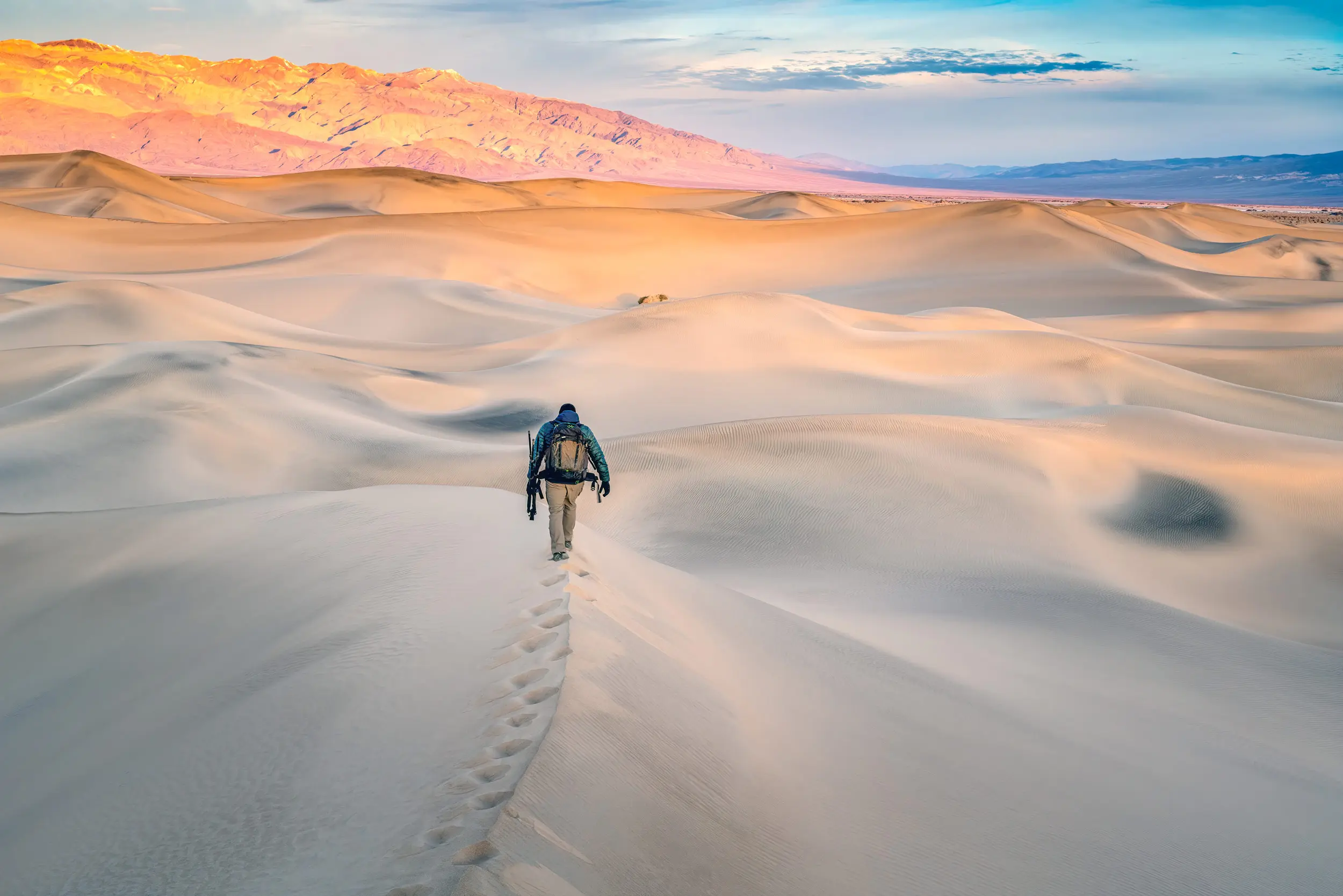
Panamint Dunes (NPS)
Although initial filming for Tatooine took place in Tunisia, Death Valley was chosen for additional scenes, partly due to the logistical advantages it offered, such as the ability to bring in Mardji, a San Francisco elephant who played a bantha, a creature native to the planet Tatooine. While Mardji’s performance was spot-on, reports suggest she wasn’t thrilled with her furry bantha costume and often tried to shake it off in true diva style.
As the Star Wars saga expanded, so did its use of Death Valley’s diverse landscapes. In Return of the Jedi (1983), the Mesquite Flat Sand Dunes near Stovepipe Wells became the Great Pit of Carkoon, home to the Sarlacc,and Lucas used Twenty Mule Team Road as the path C-3PO and R2-D2 took to Jabba the Hutt’s Palace. Attack of the Clones (2002) included shots of Padmé Amidala and Anakin Skywalker approaching a moisture farm on Tatooine, filmed at the Mesquite Flat Sand Dunes. More recently, the Disney Plus series The Mandalorian has utilized Death Valley’s panoramic vistas to create contemporary cinematic representations of the iconic dust planet.
What many fans might not know is that when these scenes were originally filmed, Death Valley was still a national monument rather than a national park. In 1994, it received national park status, bringing new protections to preserve the park’s natural and cultural resources. With these increased protections in place, filming of this intensity is now more carefully regulated to ensure the landscape and wildlife remain undisturbed, while also maintaining a positive experience for visitors.

(Courtesy of NPS)
Here are 6 must-visit spots where you can explore Star Wars filming locations, starting at Artists Palette and ending near Stovepipe Wells!
We also recommend checking out Steve Hall’s website (https://www.panamintcity.com/exclusives/starwars.html) for matched-up photos of 29 specific camera angles from A New Hope and Return of the Jedi. Alternatively, download the free NPS App (https://www.nps.gov/subjects/digital/nps-apps.htm) for a guided audio tour of Death Valley’s Star Wars sites.
1. Artists Palette
- Sandcrawler Station: Near the Artists Palette parking area, look for the unmarked gulch south of the turn into the parking lot where the Jawas’ Sandcrawler scenes were shot.
- R2’s Arroyo Overlook: From the parking area, walk up the small hill to the north to see where R2-D2 was filmed trekking through a narrow canyon.
- Inside R2’s Arroyo: Walk left into the unmarked gulch that runs along the north side of the parking lot. This is the area where Jawas captured R2-D2 and where he was zapped by them in the film.
2. Desolation Canyon
- Bantha Canyon: From the Desolation Canyon parking lot, there is 3.6 mile out-and-back trail to the area that was used for scenes featuring Tusken Raiders riding Banthas. Walk east, staying north of the small hill instead of going directly over it. You’ll drop into a wash that leads to Desolation Canyon, with Bantha Canyon just before the canyon’s mouth.
3. Golden Canyon
- Jawa Canyon: From the Golden Canyon parking area, follow the trail to the mouth of the canyon. This area, known as “Jawa Canyon,” was used for scenes of the Jawas’ attack in A New Hope. It also features other memorable scenes, such as when Luke was struck by Tusken Raiders.
4. Twenty Mule Team Canyon
- Lightsaber Construction Cave: Drive into Twenty Mule Team Canyon and turn onto the gravel road. Look for the collapsed cave in a small canyon on your right where Luke Skywalker constructed his lightsaber.
- Road to Jabba’s Palace: Continue driving through the canyon to follow the road to where Luke sent C-3PO and R2-D2 to Jabba the Hutt’s Palace.
5. Dante’s View
- Mos Eisley Overlook: Drive to Dante’s View off Highway 190. Enjoy the sweeping view from the overlook, where Obi-Wan, Luke, and the droids viewed Mos Eisley.
6. Mesquite Flat Sand Dunes
- Droid Dunes: Conclude your tour at the Mesquite Flat Sand Dunes near Stovepipe Wells. Hike halfway out to the dunes and look northeast to match the backdrop where R2-D2 and C-3PO were seen lost in the Tatooine sands.